

The Bottom Rung
AI may be a miracle for the country and a nightmare for people just starting out in their careers. The question is what we'll do to help them find their footing and bounce back.


A note to existing subscribers: Policy Gradients now serves as the publication for the AI Team at the Foundation for American Innovation and will continue to feature contributions from Daniel King.
Over the last year, people at the White House have been asking me when artificial intelligence is going to take all our jobs—sometimes jokingly, sometimes deadly seriously. They asked it in hallways, and in meetings, and once or twice in the time it takes an elevator to climb three floors.
And for a year I never quite knew where to look on the wall or floor or ceiling as I told them I didn’t think AI would leave them unemployed. The people asking had the safest jobs of any—they have a line item in the federal budget—and beyond that, the evidence for broader layoffs was thin.
Hunting for Apocalypse
Some of the evidence showing job loss was unlikely came from my own desk. A coauthor and I went looking for the tremors of the AI apocalypse in the place they ought to show up first: the workplaces most exposed to AI. In a neatly controlled study, we found essentially the opposite.
We compared each local industry to the same industry in other states, knowing that exposure to AI varies with the work a place happens to do: the oil-and-gas business in Texas leans on more coders and marketers than the oil-and-gas business in Oklahoma, for instance. With enough industries and enough states, you can pull the effect of AI exposure apart from whatever else is moving a given state or sector. Neat trick.
What we found surprised us. More exposed local industries had posted not only substantial gains in output but impressive gains in employment as well (Johnston and Makridis, 2026). Where a sector’s exposure to AI rose by a standard deviation, output ran about 7 percent higher and employment about 4 percent higher—good news all around.
If the machines were coming for our jobs, we would have expected falling employment amid rising output. Instead, the two climbed together. What this suggests is that AI has been making workers more productive and therefore more valuable—employers want to hire more workers when benefited by AI. Thus a sizable portion of all that new output found its way to additional workers rather than the technology arriving as a blizzard of pink slips.
The theory here is also strong, fitting an old pattern in economics called Jevons’ Paradox: When something becomes more efficient, we tend to use more of it, not less. When coal can be used more efficiently, you might think we need less coal—one lump could do the job of three. But we actually used more—not less—because our demand for coal was elastic (that is, demand is quite sensitive to price). Seeing the same pattern among workers in the age of AI suggests that employer demand for human tasks is also elastic: they demand actually more human labor when augmented by AI. Phew.
And I Was Not Alone
Other researchers with different designs were finding similarly non-apocalyptic patterns.
One tracked how quickly firms on both sides of the Atlantic were actually putting these tools to work, then asked whether all that adoption had reduced the employment numbers at all. It hadn’t, not yet, not in the United States and not in Europe (Bick et al., 2026). The displacement everyone was bracing for simply wasn’t apparent there in the data.
Another used detailed survey data in Denmark, where workers took up AI early and the government records very nearly everything. Researchers surveyed 25,000 people across 11 exposed occupations and 7,000 workplaces, then matched their answers to administrative records on the hours and earnings of each worker (Humlum and Vestergaard, 2025). But contrary to the Apocalypse Hypothesis, the effect of AI adoption on actual earnings, and on actual hours worked, was a precise and stubborn zero.
Something Amiss
But as the year went on, I became less certain that nothing was amiss. What unsettled me was not a forecast: it was that the labor market for young people looks very strange.
First, computer science majors are clocking some of the highest unemployment rates of any college graduates, right up there with anthropology and art history (NY Fed, 2026a). Historically, the most technical majors were also the most employable. And computer science just happens to be a skill that AI excels at, being textual and predictable in nature.
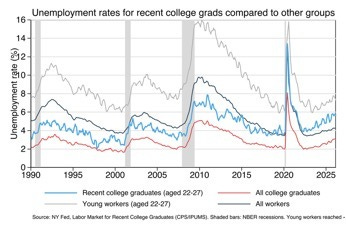
Second, college grads in general are not enjoying some of the labor market benefits they long had. For decades, recent college graduates were systematically less likely to be unemployed than the average American worker. And the gap was not small: the broader workforce carried something like a 30 percent higher unemployment risk than the young and freshly credentialed (NY Fed, 2026b).
The recent graduate employment advantage hasn’t just shrunk, or disappeared: it has flipped.
Young college grads are now trailing behind the workforce average that they used to lead. They now carry an unemployment risk about a third higher than workers as a whole (NY Fed, 2026b).
What’s more, young college grads in the past tended to have more resilient employment than peers without a college degree. When unemployment went soaring among non-grad 20-somethings, it remained low and anchored for recent grads. Now, somewhat ominously, their rising unemployment rate is perfectly parallel with other young people’s.
While there are a few potential explanations—the emergence of remote work, scarring from covid isolation, and the learned brittleness of campus culture—most observers gravitate to the elephant in the room: AI is a lot like a young 20-something employee, but it remembers what you say and never rolls its eyes when you say it.1
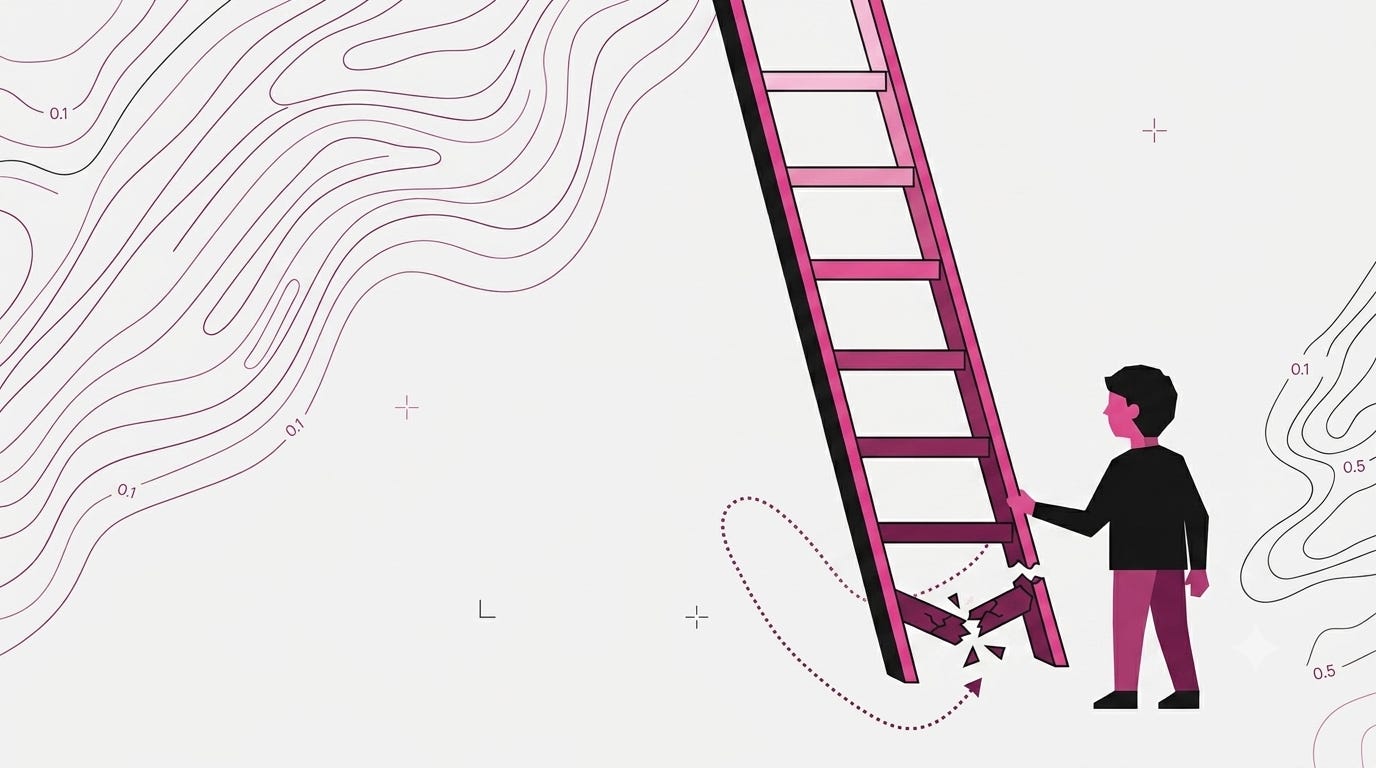
Meanwhile, Claude and Grok are much better substitutes for young college graduates than they are for senior managers or neighborhood plumbers. The first-year analyst summarizing a document, drafting a memo, or cleaning a dataset is doing precisely the work a model now does instantly and for the price of electricity. Could that be the explanation? Could an AI chatbot be quietly sawing off the bottom rung of the ladder while leaving the higher rungs relatively untouched?
The First to Feel It
In an image fit for cinema, miners plumbing the depths of the earth would carry a lamp in one hand and a bird cage in the other, down into the coal mines. The little yellow bird, smaller and quicker to feel the air go bad, would stop singing while the men still felt fine.
In other meetings, the White House has asked me who the canaries of this technological change are. The ones who fall silent first seem to be the very young, and the people who work for themselves.
The Freelancers Go Quiet
The first canary was the freelancer, and you can watch this one from two perches: the work that gets posted, and the money that gets spent.
From the first perch, economists studying one of the large global freelancing platforms watched the postings for the kind of work a chatbot can do, writing and coding, fall 21 percent within months of ChatGPT’s release, measured against manual jobs no model can touch (Demirci et al., 2025). When the image generators arrived, the postings for illustration and image work fell 17 percent in the same period.
From the second perch, an analysis of corporate spending found that the share of company budgets going to freelance workers fell significantly as companies scaled their AI spend (Stevens, 2026). More than half of the firms that had hired freelancers in 2022 had stopped entirely by 2025.
The Youngest Go Quiet
The second canary was young workers.
A team at Stanford went into the payroll records of ADP, the largest payroll processor in the country, and followed millions of workers month by month from 2021 into the fall of 2025 (Brynjolfsson et al., 2025). Once they had accounted for whatever was happening to each company as a whole, a pattern surfaced that was hard to explain any other way.
Workers between 22 and 25, the just-hired and the just-graduated, saw their employment fall 16 percent in the occupations most exposed to AI, while their older colleagues in those same occupations held steady or kept growing.
What was strange is that the young were not taking pay cuts—those who had jobs saw rising wages. They were simply less likely to be hired to begin with. (This pattern of rising wages and falling employment is not consistent with the story of falling demand for young pros, where wages and employment would move in tandem.) And the drop was steepest exactly where the technology does the work instead of helping with it, in software development and customer service. The researchers tried to make the finding disappear. They dropped the technology firms; they dropped the work-from-anywhere jobs; they ran the same test on the years before the models arrived. The effect persisted.
I didn’t initially know exactly what to make of this finding, mostly because the same patterns were not visible in aggregate data—the employment rate of recent computer science and marketing grads did not change significantly. And maybe the ADP data picked up on something that wasn’t in the labor market more generally. Maybe the sample was not representative because it ignored entering firms that were picking up the slack left by stable firms.
But then a second team, working from an entirely different dataset and different research design, found the exact same thing. They read the résumés of 62 million workers across roughly 285,000 American firms and used job postings to tell which companies had begun adopting generative AI, flagging a firm as an adopter once it started hiring AI-adoption specialists (Hosseini and Lichtinger, 2025).
At the time of adoption, junior employment fell while senior employment kept growing. And it fell not because anyone was being let go but because the firms had quietly stopped hiring young people. Young people weren’t kicked out en masse; they were simply less likely to ever be invited in in the first place. The authors call the pattern seniority-biased technological change, but they could have called it boomer-biased technological change, a sorting of the workforce in which the people who arrived first are kept on and the people arriving now are turned away at the threshold.
No Slack To Begin With
While young workers are especially exposed to AI, the rung they’re reaching for was already quite worn, cracked, and ready to give way.
For instance, a generational housing shortage has made home ownership increasingly difficult for young people (while making the homes of older generations ever more valuable—a terrible transfer of wealth). The price of a typical home against a typical income sits near its highest in decades, the payment on a first mortgage now eats the largest share of income in 40 years, and home ownership among those under 35 runs significantly below where it stood in the past, and this for a generation more credentialed than any before it.
Those credentials are another thing. The real net cost of a four-year public degree has roughly doubled since 1980. And for that increase, young people now carry $1.7 trillion in federal student debt, yoking some 43 million borrowers. Meanwhile something like four in ten recent graduates are working in jobs that never required the degree they are still paying off.
At the same time, the public purse has tilted, steadily and without anyone quite deciding that it should, toward those who already have the most behind them. Washington spends nearly six times as much per person on Americans over 65 as on those under 18, though the young are doing more poorly than the old had at their age. And the cost of the past has come due in the present, which the young will bear disproportionately: federal net interest alone has now passed $1 trillion a year, borrowed against a future these young people will spend their working lives working to repay.
You can see all of it in how they live, if you are willing to read it as something other than a flaw of character. A record 52 percent of those between 18 and 29 were living with their parents in 2020. Today’s young adults hold meaningfully less wealth than the boomers did at the same age, and something like 40 percent less than Gen X had managed by then (Kurz et al., 2018). Among young men especially, the money that might once have gone toward a down payment now goes, in unsettling volume, into sports books and cryptocurrency, the only games that still seem to promise a fast way up. Marriage has fallen to the lowest rate on record. And in 2024 the total fertility rate dropped to about 1.6, the lowest in the nation’s history and well beneath the level a country needs simply to maintain itself.
I do not read those last numbers as recklessness or as some failure of nerve. I read them as a generation improvising. They are placing small bets, staying home, putting off the marriage and the house and the child, because the footholds their parents relied on to climb into adulthood have been filed smooth one by one.
The Better Question
So where does this leave that blank-looking economist who kept not knowing where to look? Less sure that everything is all right.
The miracle is real. AI is doing what would have looked like magic in The Jetsons or Star Trek; the breakthroughs and the added years of life are real. But an aggregate is a cold thing to hand a 23-year-old who can feel the bottom giving way beneath her, and who reads the good national numbers the way you’d read fine weather in a country you no longer live in.
We don’t know what the future holds; anyone who says they do is selling something. Today’s troubles could be Covid, or remote work, or AI; what we can make out is only a shadowy outline that might be lasting dislocation, a passing blip, or a statistical mirage. But here is the thing about a canary: it goes quiet while the air still seems fine to everyone else, and you do not wait for proof before you climb toward the surface. The question was never whether AI would take all the jobs. It is whether—however a person loses their footing—we will have built something to help them find it again.
So far, we have not. What that would take is what I mean to turn to next.
The most rigorous version of the remote-work case is Lambert and Schindler (2026), who show that the apparent effect of AI exposure on early-career hiring largely disappears once they control for firms’ adoption of remote work. Were it to hold up, this would be welcome news, since remote work is a lever firms and governments can pull far more readily than they can blunt the effects of AI. But the design tilts toward its own conclusion. Their sharpest specification races a finely measured variable—actual, firm-level work-from-home adoption, observed in job postings—against a coarse one: an occupation-level index of predicted AI exposure, which captures potential task overlap rather than any firm’s actual use. Because remote work and AI exposure fall on nearly the same set of desk jobs, the two measures are highly correlated, and when correlated proxies of unequal precision enter a regression together, ordinary least squares attributes their shared signal to the better-measured one and drives the noisier one toward zero (Lubotsky and Wittenberg 2006). That work-from-home survives and AI vanishes is thus close to a foregone conclusion of how the two are measured—not evidence that AI is doing little. The test tells us which variable is measured more cleanly, not which force matters more.
 | A guest post by
|