

The Manufacturing of the Future Won’t Be Human-Shaped
The case for industrial robots


Most factories are built to be used by humans. Conveyor belts are at hand height, walkways and stairs are designed for human maneuvering, warning lights and alarm systems are meant to be perceived by humans, etc.
Automation has, so far, mostly been built around a human-shaped environment. Industrial robots typically operate in fixed cells in order to prevent human injury, and even automated systems are still meant to facilitate human monitoring and involvement. OSHA guidelines for the deployment of industrial robots specify that they should be enclosed in specific parts of a factory with guardrails to protect human workers, operate at reduced speeds around humans, and be de-energized for maintenance, among others (at least 26 different standards dictate how to safely deploy industrial robots around humans). While industrial robots go back to the ’50s, their roles in industry have stayed somewhat narrow: industrial robots mostly perform hard-coded, repetitive tasks, like placing identical panels on identical car frames.
Humans still do many essential tasks in manufacturing. Even in the most automated industries, the management and organization of factory floors is still done by humans, much of the coordination across machines is done by humans, and many discrete tasks, like sewing fabrics, are still done almost entirely by humans.
Humanoids are useful as transition labor
Because factories are human-shaped, humanoid robots can usefully substitute one-for-one into human spaces without much retrofitting.
In the short-run, it will probably be valuable to deploy humanoids into factories: once the cost of a humanoid falls below the cost of human labor, or a humanoid sufficiently improves speed or quality that it’s worth an extra cost, it would be economical for factories to sub humanoids in for human labor. And doing so theoretically wouldn’t take much time or extra cost – factories are already designed for human bodies, and wouldn’t require much redesign to accommodate humanoid labor. For example, while humanoid capabilities are still limited, humanoid robots have been deployed in warehouse settings to move containers, using the same infrastructure and equipment as humans.
Additionally, humanoids are, in some ways, easier to train models for. In particular, lots of data for robotics comes from motion data captured (placing sensors on humans doing real-world tasks) or from teleoperation of robotic systems by humans. It’s easier to port this data over to a humanoid form factor, since it is based on human-shaped motions.
But humanoids are not the electric dynamo
When factories first replaced steam engines with electric motors, they kept the same layout for the factory floor, with many-storied buildings organized around a central engine. This led to only minor productivity improvements, because machines had to be close to the central engine rather than organized according to the production process. Real productivity gains only came once engineers entirely redesigned the floor plan around the natural flow of the production line, which could only be done once machines had their own power source.
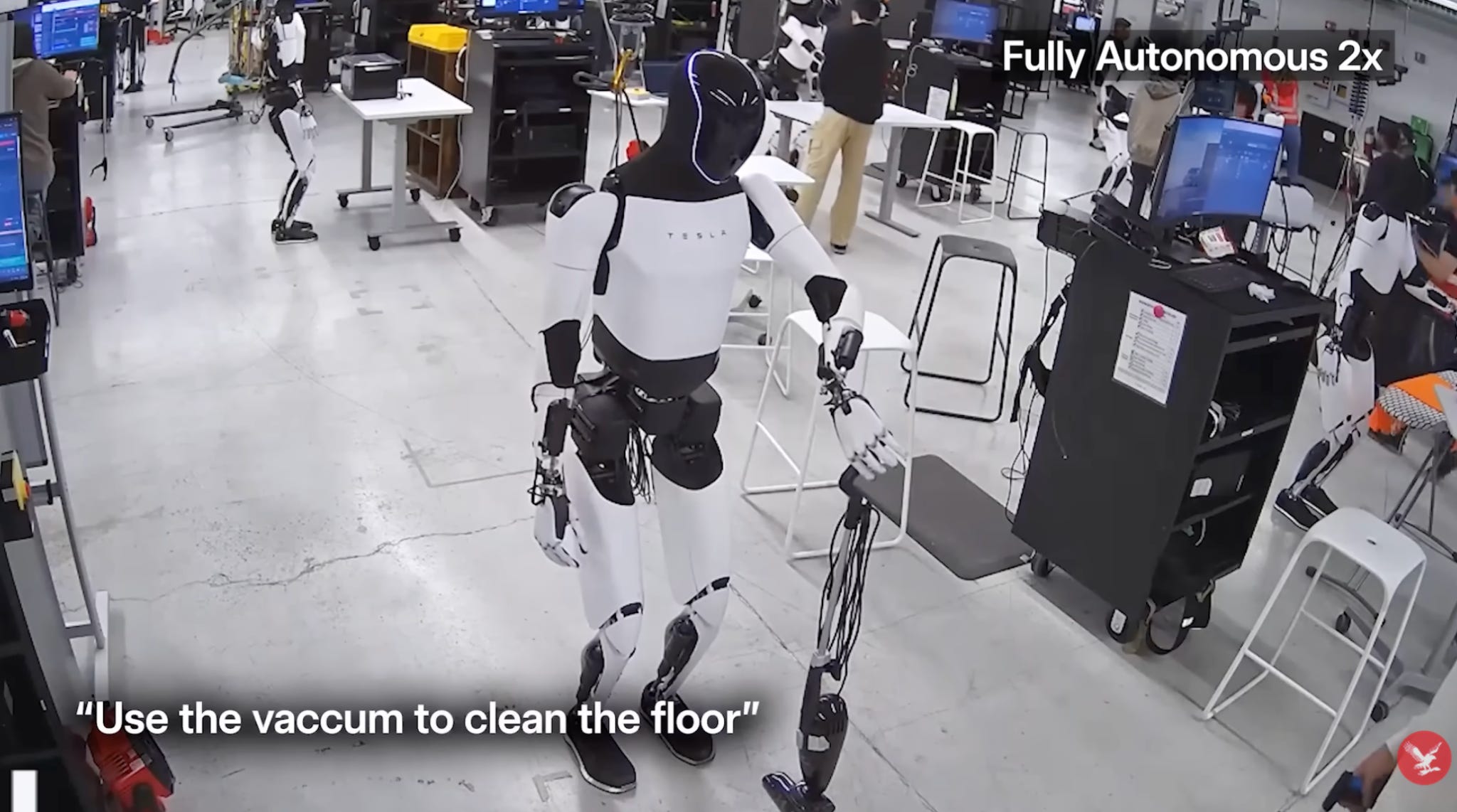
Humanoids are probably more like swapping steam engines for electric motors than redesigning the factory floor. It would be surprising if the human form factor is optimal for most tasks. Indeed, there are already many examples of humanoids trying to do tasks that can already be performed more competently by non-humanoid robots (see, e.g., humanoids shoveling snow, vacuuming, and driving cars).1
AI integration could reorganize how factories work
Unlike humanoids, industrial robots are able to do many of the core subtasks that are necessary for manufacturing, like welding, drilling and fastening, and moving heavy parts. However, there are many things industrial robots cannot do, including tasks that require particular dexterity, coordinated motions with other systems, or complex planning. AI integration into industrial robots could potentially change that by enabling new capabilities.
First, AI integration into robotic systems could allow robotic systems to adapt to changing production processes. Currently, to deploy an industrial robot, a factory typically needs to make sure that every widget going down a production line is in the same place, with the same orientation, so that the hard-coded motions of the industrial arm will interact properly with the widget each time.2 This is expensive and time-intensive, and is why most of the cost of installing an industrial robot is the installation and setup cost – not the robot itself. AI integration into robotic systems could enable industrial robots to handle more complex or variable production processes, and do so with lower setup costs. A few concrete examples of manufacturing processes where AI integration might improve productivity:
Textile processing: Fabric is limp and deforms unpredictably, which has made automated sewing one of the most difficult industrial processes to automate. Currently, attempts to automate textile processing work around the problem by doing things like chemically stiffening the fabric so that rigid, hard-coded robots can handle it like sheet metal. AI-driven perception and force control could let robots manipulate fabric directly.
Wire harness assembly: Assembling wiring for a car is one of the last almost-entirely-manual processes in automotive manufacturing. Deformable linear objects like wires have historically been difficult for industrial robots to handle, and the combination of deformable wires with complex wire layouts has long made it the hardest assembly job to automate. Recent efforts have made some progress with integrating simple AI systems into industrial robots to enable them to handle parts of the wire harness assembly process, and further AI progress could enable significantly more automation of the process.
In particular, greater AI capabilities in industrial robots could enable robots to perform tasks that are especially dangerous to humans but difficult to fully automate due to variability:
Foundry fettling and grinding: Cleaning excess metal off castings exposes workers to heat, noise, and respirable crystalline silica. Despite this, it remains labor-intensive and hazardous because each casting comes out slightly different, which is more variability than can be properly handled by hard-coded robotic grinding.
EV battery disassembly: Taking apart battery packs for recycling exposes workers to risks like electric shocks, explosions, and fires, yet it remains largely manual because pack designs vary so much across manufacturers and generations.
Shipyard welding: Ship welding, especially inside hull blocks, exposes workers to heat, dust, and fumes in confined spaces, but conventional robotic welders struggle with the variable geometry and cramped spaces of ship structures. Shipyards are starting to deploy AI-guided welding robots in narrow use cases, but still rely on human welders in most cases.
Additionally, AI integration could allow coordination across multiple robotic systems. One model of an advanced factory is a centralized AI controller that orchestrates the motions of multiple industrial robots synchronously without the need for human involvement. This level of coordination would enable more complex production processes than a given robot could support. Simple versions of this already exist in the form of highly automated lights-out factories, including robot manufacturer FANUC’s highly automated robot-assembling factories and Xiaomi’s phone-assembling plants, both of which rely on lots of industrial robots operating with minimal human supervision. However, the motions of the robots in these factories are highly repetitive with minimal variability – any change in the production process would require humans to reprogram the robots in the factory. AI-driven factory orchestration would enable both more complex and more variable production processes at a factory level.
The building blocks of future manufacturing already exist
Some of the basic components of industrial robots – joints, grippers, precision actuators, and end-effectors – are probably going to be needed in basically any manufacturing setting, as will the core competency of coordinating multi-axis movement. It’s hard to imagine advanced manufacturing that doesn’t involve, e.g., joints and grippers.
This is true even of humanoids. A humanoid is, functionally, a couple of manipulators mounted on a movable system. The parts of the humanoid that can do welding, fastening, or handling are arms built from the same components as an industrial robot, like precision reducers; the legs and torso mostly serve to carry the manipulators to the workstation.
And for an important segment of manufacturing, the human form factor is ruled out entirely. Humans cannot lift 2,000kg, transfer semiconductor wafers without damaging or contaminating them, or operate in high-heat environments. These are also tasks not done by mobile robots without arms (e.g., warehousing AMRs) – they fundamentally require durable manipulators.
Manufacturing in the future will probably look quite different from the factories of today, in the same way the factories of the electric dynamo looked different from those a generation prior. Future systems might be multi-armed, mobile, more articulated, integrated into larger coordinated systems, etc. It’s hard to know exactly what manufacturing in the future will look like, but its building blocks will probably come from industrial robots.
For the improved non-humanoid versions of these, see an autonomous snowblower, robot vacuums, and self-driving cars.
There’s been some progress with integrating vision ML and adaptive trajectory correction into existing industrial arms, but the capabilities here are still limited to repetitive and predictable actions.
 |
|